This is a numerology tool. It uses your date of birth only, with no birth time, no birth place, and no planetary calculation, so there is no ayanamsa involved and no chart is being cast. The grid is arithmetic and tradition, and presenting it as astronomy would be dishonest.
Read the grid as a description of emphasis rather than a diagnosis. A missing number is not a defect and a repeated number is not a superpower; both are simply features of a date. Nothing here is medical, legal, or financial advice, and no arrangement of digits guarantees anything about your life.
What the Lo Shu grid is
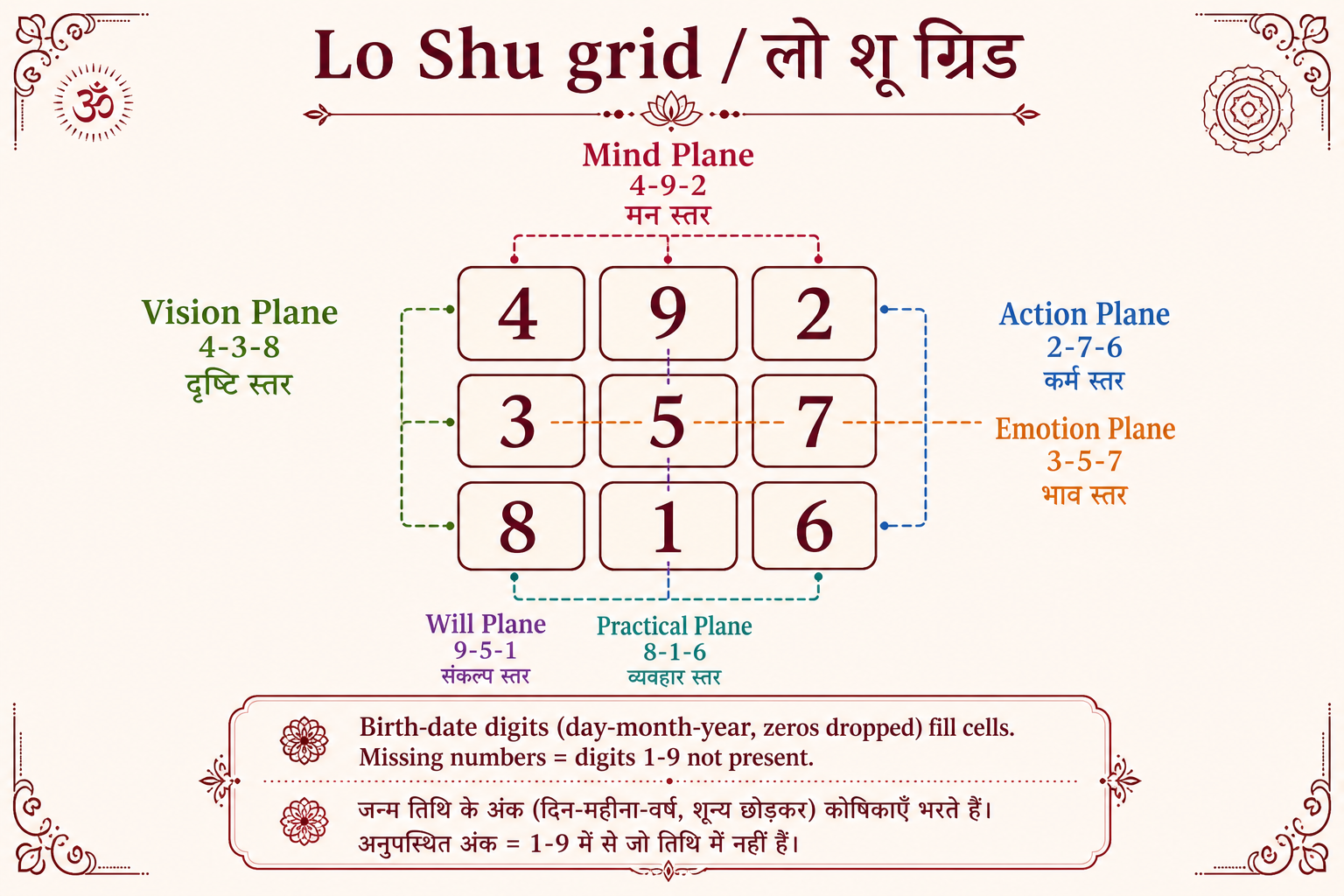
The Lo Shu square is a three-by-three arrangement in which every row, column, and diagonal adds to fifteen. The traditional layout places four, nine, and two in the top row; three, five, and seven in the middle; and eight, one, and six at the bottom. Each cell has a fixed position that never changes.
To build your grid, write out your full date of birth as digits and place each one in its matching cell. A birth date of 27 March 1994 contributes two, seven, zero, three, one, nine, nine, and four — so the nine cell holds two entries, the zero is set aside, and several cells stay empty.
Most practitioners also add the mulank and bhagyank as extra entries, and some add a third derived number called the kua. This tool shows the base grid first and the expanded version separately, so you can see which pattern comes from the raw date and which comes from the additions.
Reading planes, arrows, and missing numbers
A completed row, column, or diagonal is called an arrow or a plane. The horizontal rows are traditionally read as thought, emotion, and practicality; the vertical columns as planning, will, and action. A completed line is read as emphasis in that area, and a completely empty line as an area needing conscious attention.
Repeated digits intensify. Three fours or three nines in a grid are described as a strong presence of that number’s qualities, which traditional practice frames as both a strength and something to moderate. A single occurrence is read as a balanced presence.
Missing numbers get the most attention and cause the most unnecessary worry. Everyone born in the two thousands is missing a one unless the day or month supplies it, which shows how much of a grid pattern is simply an artefact of the calendar rather than a statement about a person.
What the grid does not tell you
The Lo Shu grid does not diagnose anything. Popular pages associate missing numbers with health conditions, financial problems, and relationship difficulties, and none of that has any basis. If a page tells you a missing four means a specific illness, close it — that is harmful nonsense dressed as tradition.
It also does not predict. The grid is fixed at birth and never changes, so it cannot describe a period, a decision, or an outcome. Numerologists who want a time layer use the personal year cycle instead, which at least varies from year to year.
Remedies sold to fill missing numbers deserve particular caution. Wearing a number, buying a yantra, or changing a name spelling to complete a grid is a commercial practice, not a classical one, and no honest reading requires you to spend money.
Worked example: building one grid
Take 27 March 1994, written as 27-03-1994. The digits are two, seven, zero, three, one, nine, nine, four. Placing them: the two cell has one entry, seven has one, three has one, one has one, nine has two, and four has one. The five, six, and eight cells are empty, and zero is not placed at all.
Now look at the lines. The top row of four, nine, two is complete, which traditional reading calls the mental or thought plane — described as an emphasis on analysis and planning. The bottom row of eight, one, six is incomplete because eight and six are missing, which is read as an area to develop consciously.
The two nines intensify that number’s associated qualities of drive and intensity. Add the mulank, which is nine for a birth on the twenty-seventh, and the nine cell now holds three entries — a pattern a numerologist would describe as strongly emphasised and worth balancing rather than celebrating.
Honest limits and next steps
Numerology has no demonstrated mechanism. The digits of a date carry cultural meaning in this tradition and nothing more, and a grid pattern is largely determined by the century you were born in. That is worth knowing before you read too much into a missing cell.
Nothing on this page is medical, legal, or financial advice. Please do not treat a missing number as a health warning or a reason for a purchase. If a reading is producing anxiety, that is a signal the reading has gone wrong, not a signal that you need a remedy.
For related layers, Personal Year Numerology gives a cycle that actually changes over time, Name Numerology looks at the spelling of your name, and Lucky Number Finder covers the basic mulank and bhagyank reading in more detail.